
 Image 1 of 1
Lesley Luce
"Evening on Canoe Lake"
16" Round Framed
Wood Panel, Canvas, Acrylic Paint, Chromalife100+ Ink, Paper
$1,400
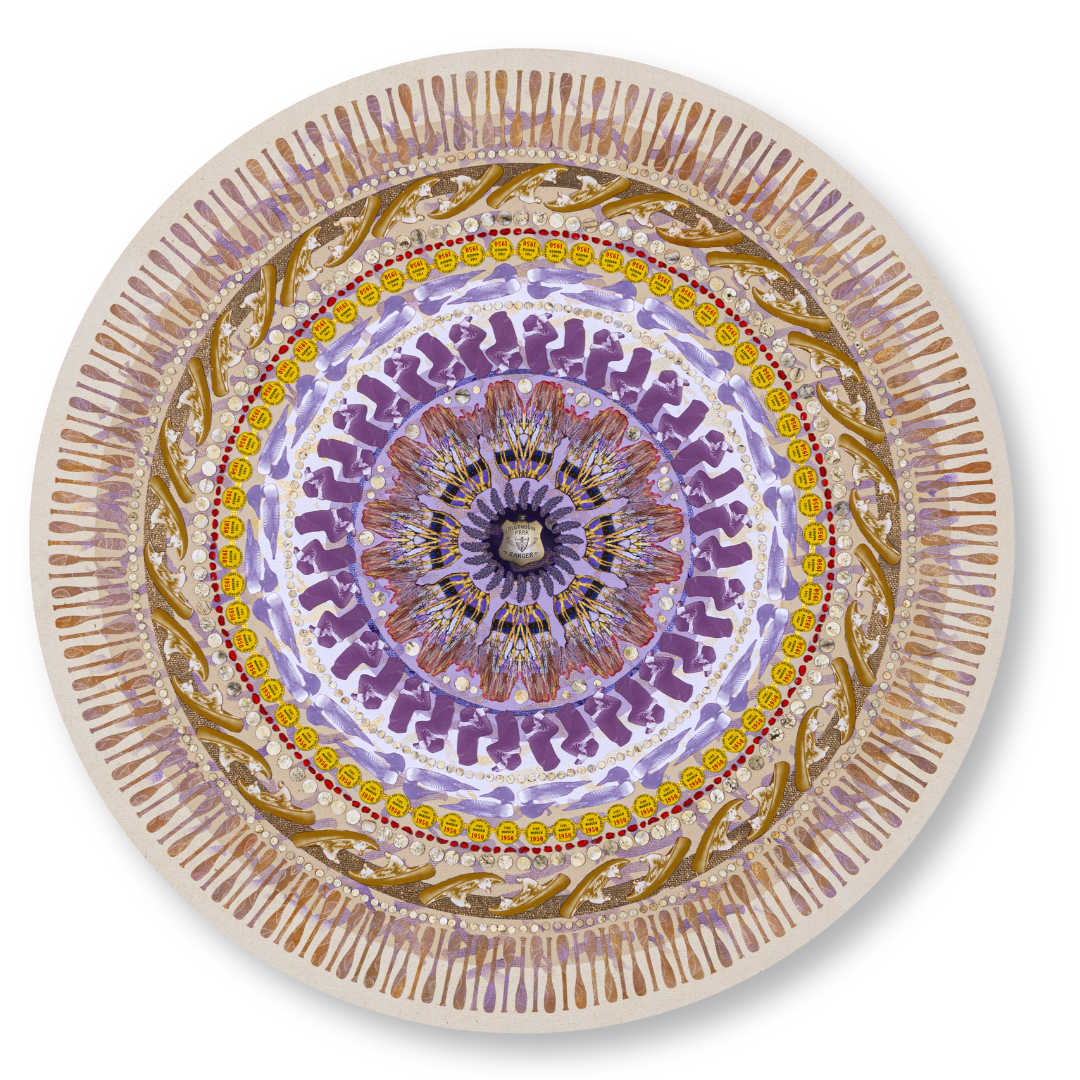
The concentric circles of Evening on Canoe Lake, Composition 0313 by Lesley Luce pay homage to Algonquin Park's rich natural and artistic heritage.
The act of creating this piece was one of quiet focus, where the repetitive layering of patterns and details became a meditative practice reflecting on personal stories and experiences on Canoe Lake.
This meticulously handcrafted piece, 16 inches in diameter, includes fragments of birch bark gathered by the artist on the lake itself. Portage signs, a traditional beavertail paddle silhouette, archival wildlife photography, and references to early 20th-century park culture are woven throughout. Visual nods to Tom Thomson's Evening, Canoe Lake, Winter (1915), and A.Y. Jackson's The Red Maple (1914) adds narrative depth rooted in Canadian art history.
From a distance, the abstract structure draws the viewer in, while closer inspection reveals intricate symbols of memory, resilience, and transformation. This work bridges personal ritual and cultural history, inviting viewers to reflect on their own connections to Canoe Lake, renewal, and quiet strength.
Lesley Luce
"Evening on Canoe Lake"
16" Round Framed
Wood Panel, Canvas, Acrylic Paint, Chromalife100+ Ink, Paper
$1,400
The concentric circles of Evening on Canoe Lake, Composition 0313 by Lesley Luce pay homage to Algonquin Park's rich natural and artistic heritage.
The act of creating this piece was one of quiet focus, where the repetitive layering of patterns and details became a meditative practice reflecting on personal stories and experiences on Canoe Lake.
This meticulously handcrafted piece, 16 inches in diameter, includes fragments of birch bark gathered by the artist on the lake itself. Portage signs, a traditional beavertail paddle silhouette, archival wildlife photography, and references to early 20th-century park culture are woven throughout. Visual nods to Tom Thomson's Evening, Canoe Lake, Winter (1915), and A.Y. Jackson's The Red Maple (1914) adds narrative depth rooted in Canadian art history.
From a distance, the abstract structure draws the viewer in, while closer inspection reveals intricate symbols of memory, resilience, and transformation. This work bridges personal ritual and cultural history, inviting viewers to reflect on their own connections to Canoe Lake, renewal, and quiet strength.